

From 2025/2026 I founded and built Vizory — an AI product for board directors — alongside co-founder Toby Vidler. I designed the product, ran the user research, made the architecture decisions, and tested with real directors using real board packs.
From the outset, we had strong hypothesis testing in place, not just for the product but also for go-to-market. As those hypotheses evolved, it became clear that board pack analysis delivers the greatest value when it's part of a broader governance offering, alongside advisory and AI capabilities that help boards understand not just what's changed, but what to do next.
The walkthrough below is the most direct way to see how I think about product, customer experience, and AI applied together.
Read the series for the full story in writing — what I built, what I tested, what I learned. Or watch the walkthrough for the most direct view of the product itself. Either path stands on its own.
What I built, what I tested, what I learned, and what I'd do differently. Around 12,000 words. Read end-to-end or pick the parts that interest you — they stand alone.
Start with Part 1 →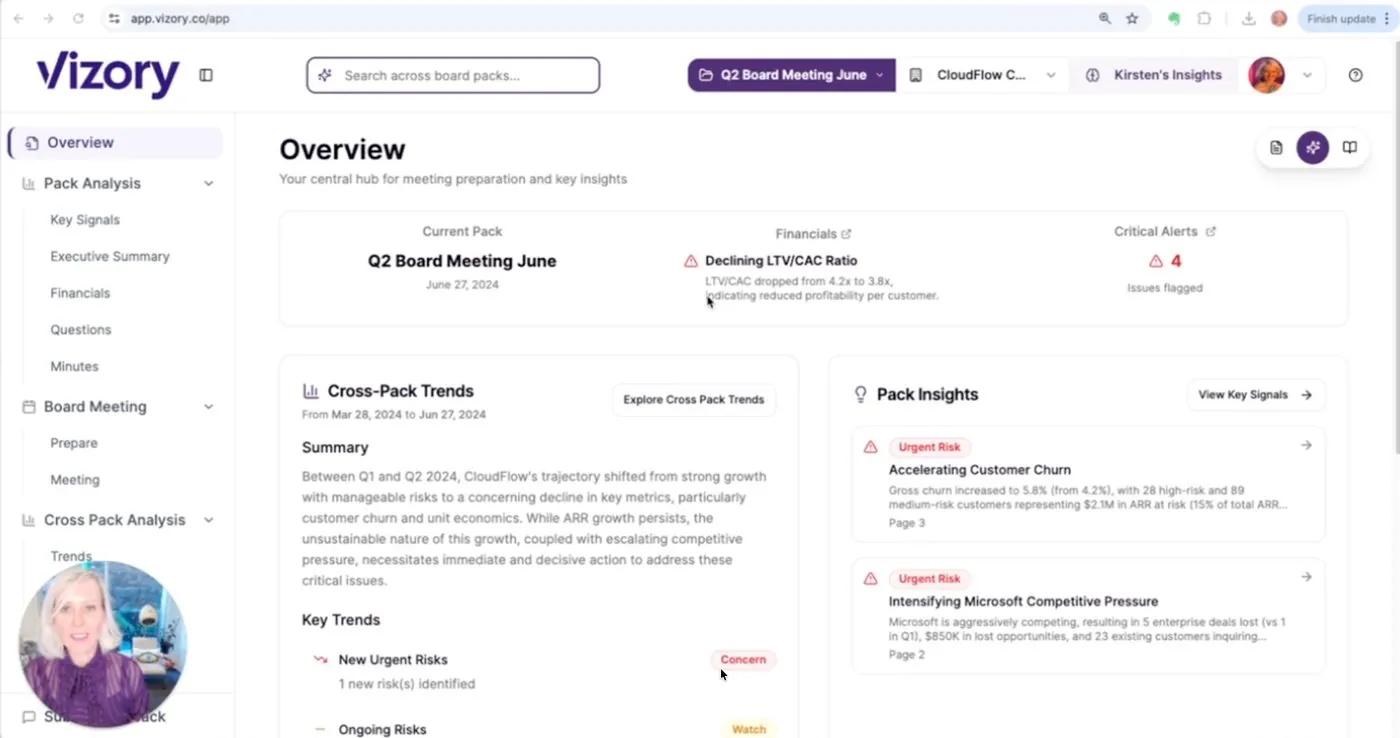
The product walked through in five short chapters — the marketing site, the product itself, and the research and architecture behind it. The most direct view of how I approach product, end-to-end.
Watch the walkthrough →Security came up within the first five minutes of every conversation. Without exception. So we built the answer into the brand and put it in the hands of every director before we asked them to use the product. These are the actual materials we shared during the early adopter programme — the kind of artefacts that make the security claim verifiable, not just stated.
The architecture decisions: AES-256 encryption at rest, TLS 1.2+ in transit, all data hosted on AWS within Australia, no offshore processing, zero external AI model training, page-level data isolation per user.
Download PDF →A checklist boards could use to evaluate Vizory's security against their own due diligence frameworks. Not marketing — a practical tool we put in directors' hands so they could verify rather than trust.
Download PDF →My co-founder Toby Vidler — who led ISO 27001 certification at Prospection across 350M de-identified patient records under GDPR and HIPAA — talks through Vizory's security posture for directors. The same brief we ran for early adopters.
Two artefacts from building Vizory that show how I work upstream of the product itself — the commercial case for the bet, and the messaging architecture that kept every touchpoint telling one story. Both are viewable in full.
The commercial argument for the product — the market, the model, and the numbers behind the bet. The original pricing is preserved as first written, with a note on how it evolved through discovery with early adopters. A worked example of how I build the case for a product before a line of it exists.
View the business case →How the whole story hangs together — the core positioning at the top, the pillars that hold it up, and the proof beneath each one. The messaging architecture I built so every touchpoint, from the marketing site to a sales conversation, said the same thing.
View the messaging house →If video isn't your thing, the same story is captured as a six-part written series — what I built, what I tested, what I learned, and what I'd do differently. Around 12,000 words across the series. Read the parts you find interesting; they stand alone.
The Sunday afternoon board pack, the prototype, the chair on the golf course, and the JTBD framework that validated the problem was structural — not personal.
Read part 1Three phases, eight directors, and what stated preference doesn't tell you about revealed preference. The discipline of testing in stages rather than ship-and-see.
Read part 2The security architecture decision that changed everything. The time-to-value problem in slow-cadence markets. Why a deeper shade of purple mattered more than I expected.
Read part 3Pricing in a niche, the anchoring trap, what product-market fit looks like when standard SaaS metrics don't apply, and the only test of value that actually matters.
Read part 4Why direct-to-director distribution hit a ceiling, why the channel has to mirror the customer, and why the answer was a broader governance offering rather than raising capital to build one.
Read part 5The unintended discoveries, the things I'd do differently, the framing work that paid off, and where Vizory has landed.
Read part 6A short video shows polish; a longer one shows the thinking. This is the Vizory build walked through in chapters — from the advisory marketing site where we first met customers, through the product itself, to the research and architecture behind it. Around twenty minutes in all; watch the chapters you care about.
A short introduction to the walkthrough — what it covers, and why I'm showing the thinking, not just the polish.
Where we first met customers — built on outcomes over features, with a real focus on security, data sovereignty and willingness to pay.
How directors cut through hundred-page board packs — surfacing key signals, risks and questions, with traceability back to the source material.
The research-driven method — stated versus revealed preference — and why the invisible architecture decisions mattered as much as the design.
From a feature-heavy first concept down to three core jobs — and the branding shift to a deeper, more considered royal purple.
Three more from the journey — the Mind the Product interview on building and exiting Vizory, the short demo we built into the product itself, and a small piece of go-to-market craft from the pilot programme.
Thirty years of building, a product built for an audience Kirsten is part of, and the commercial post-mortem most founder stories skip. The most direct summary of the Vizory journey and what it taught her about product, distribution, and AI.
Listen and watch the full interview →The short demo we embedded inside Vizory itself — the quickest way to see what a director actually does with a board pack once the AI has been over it.
A piece of go-to-market craft — how a short, personal video got pilot customers off the fence and into the programme. An example of the channel thinking behind the build.